OKR Implementation Hacks That Drive Faster Results
KR Implementation

What if I told you that your OKR Implementation might be slowing your growth instead of accelerating it?
According to Harvard Business Review, 70% of organizations fail at strategy execution.
And in many cases, the reason isn’t lack of talent, funding, or effort—it’s because OKRs are being implemented the wrong way.
Leaders fall into common traps: setting too many objectives, focusing on activities instead of outcomes, or treating OKRs as paperwork instead of a living, breathing system.
The result?
Teams lose focus, alignment breaks down, and growth stalls.
When done right, OKR Implementation can double alignment, boost engagement, and accelerate results by up to 30% (Gartner).
The secret lies in mastering a few powerful hacks—practical strategies that simplify OKRs, make them stick, and turn them into a growth engine.
In this article, we’ll explore 10 proven OKR Implementation hacks that guarantee faster results, backed by research, case studies, and real-world insights. By the end, you’ll know exactly how to transform your OKRs from frustrating to game-changing.
10 Detailed OKR Implementation Hacks
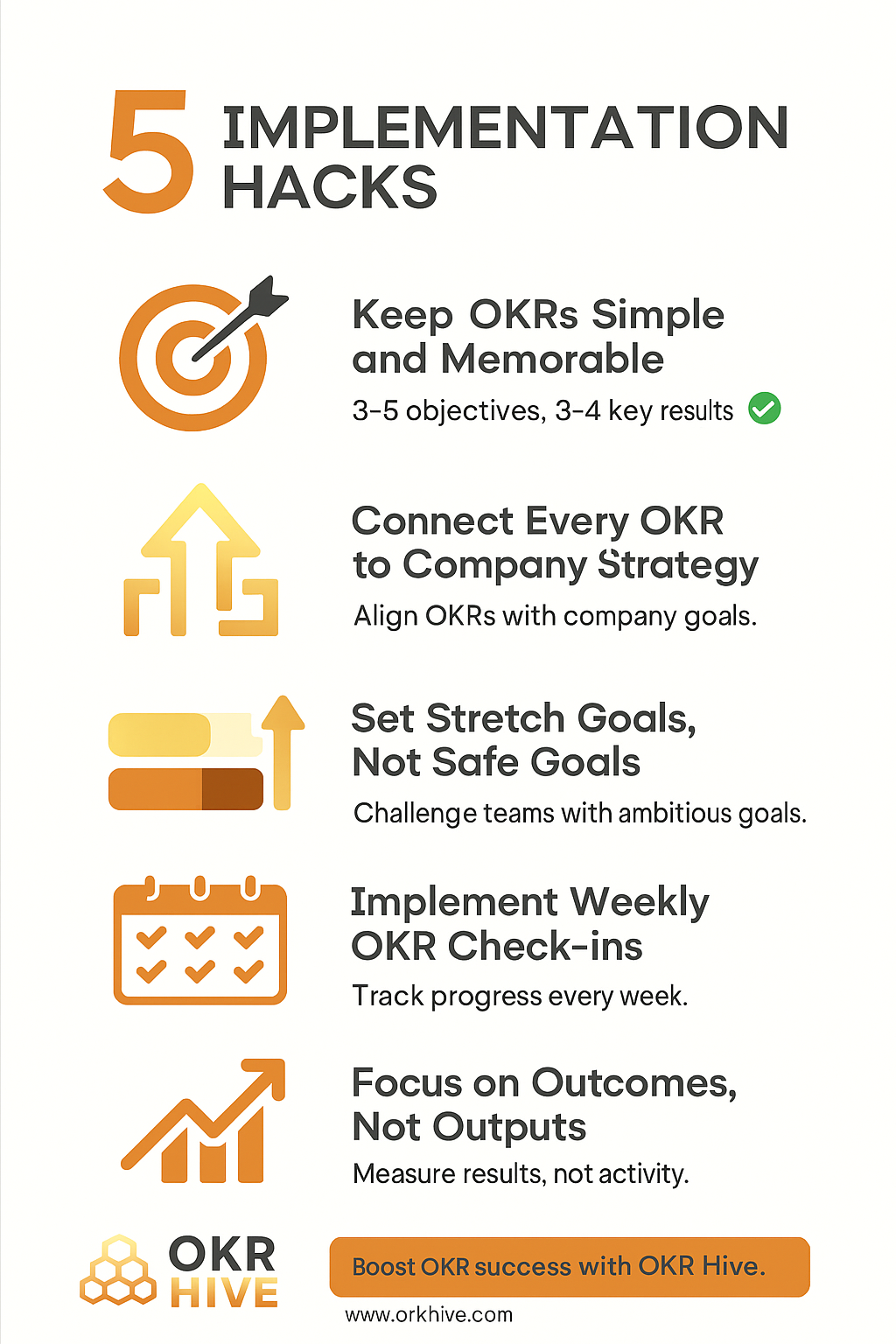
1. Keep OKRs Simple and Memorable
Complex OKRs overwhelm teams. Too many objectives or unclear key results make your OKR Implementation ineffective.
Why it matters: Simplicity improves focus. Teams remember their OKRs without constantly checking documents.
How to do it:
Limit objectives to 3–5 per team per quarter.
Each objective should have 3–4 measurable key results.
Use plain, inspiring language. For instance:
❌ “Optimize cross-functional synergy to increase departmental KPIs”
✅ “Boost sales team productivity by 20% this quarter”
Pro tip: Test recall—ask a team member to state their OKRs from memory. If they struggle, simplify further.
2. Connect Every OKR to Company Strategy
Many organizations fail because OKRs are set in isolation, not linked to the company’s north star metrics.
Why it matters: Alignment ensures that every team’s efforts contribute to strategic growth, not random tasks.
How to do it:
Start with top-level company OKRs (e.g., “Expand market share in Europe by 15%”).
Cascade objectives downward to departments and teams.
Ensure key results are measurable and contribute directly to the company OKR.
Example:
CEO Objective: Expand into Europe.
Marketing Objective: Generate 500 qualified leads in Europe.
Sales Objective: Close $1M in European revenue.
This creates a clear line of sight between company strategy and day-to-day execution.
3. Set Stretch Goals, Not Safe Goals
Employees often set “easy to achieve” OKRs, thinking 100% completion equals success. Ironically, hitting 100% consistently often means goals are too easy.
Why it matters: Stretch goals drive innovation, ambition, and performance improvement.
How to do it:
Encourage teams to target 70–80% achievement—enough to challenge, but still attainable.
Reward learning and experimentation, not perfection.
Frame it as a growth opportunity: “Even if we hit 75%, we’ll have learned insights to drive next quarter’s results.”
Research shows companies that embrace stretch OKRs innovate faster and improve overall performance by 25–30%.
4. Implement Weekly OKR Check-ins
Quarterly reviews are not enough. Teams lose focus and momentum if OKRs aren’t reviewed regularly.
Why it matters:
Weekly check-ins reinforce accountability, allow early course correction, and keep teams aligned.
How to do it:
Schedule 15-minute weekly OKR standups.
Focus discussions on three questions:
What progress was made last week?
What obstacles are in the way?
What will we focus on next week?
Track updates in real-time dashboards, not static spreadsheets.
Pro tip: Tools like OKR Hive allow live tracking, comments, and visual progress, saving time and boosting engagement.
5. Focus on Outcomes, Not Outputs
Most organisations make the mistake of measuring tasks instead of impact.
Why it matters: Tracking activities doesn’t reflect whether you’re moving the needle on business goals.
How to do it:
Convert key results from outputs (what teams do) to outcomes (what they achieve).
Examples:
❌ “Launch 5 email campaigns”
✅ “Increase email-driven MQLs by 20%”
Ensure outcomes are specific, measurable, and time-bound.
Pro tip: Ask: “If this activity didn’t produce measurable change, is it really a key result?”
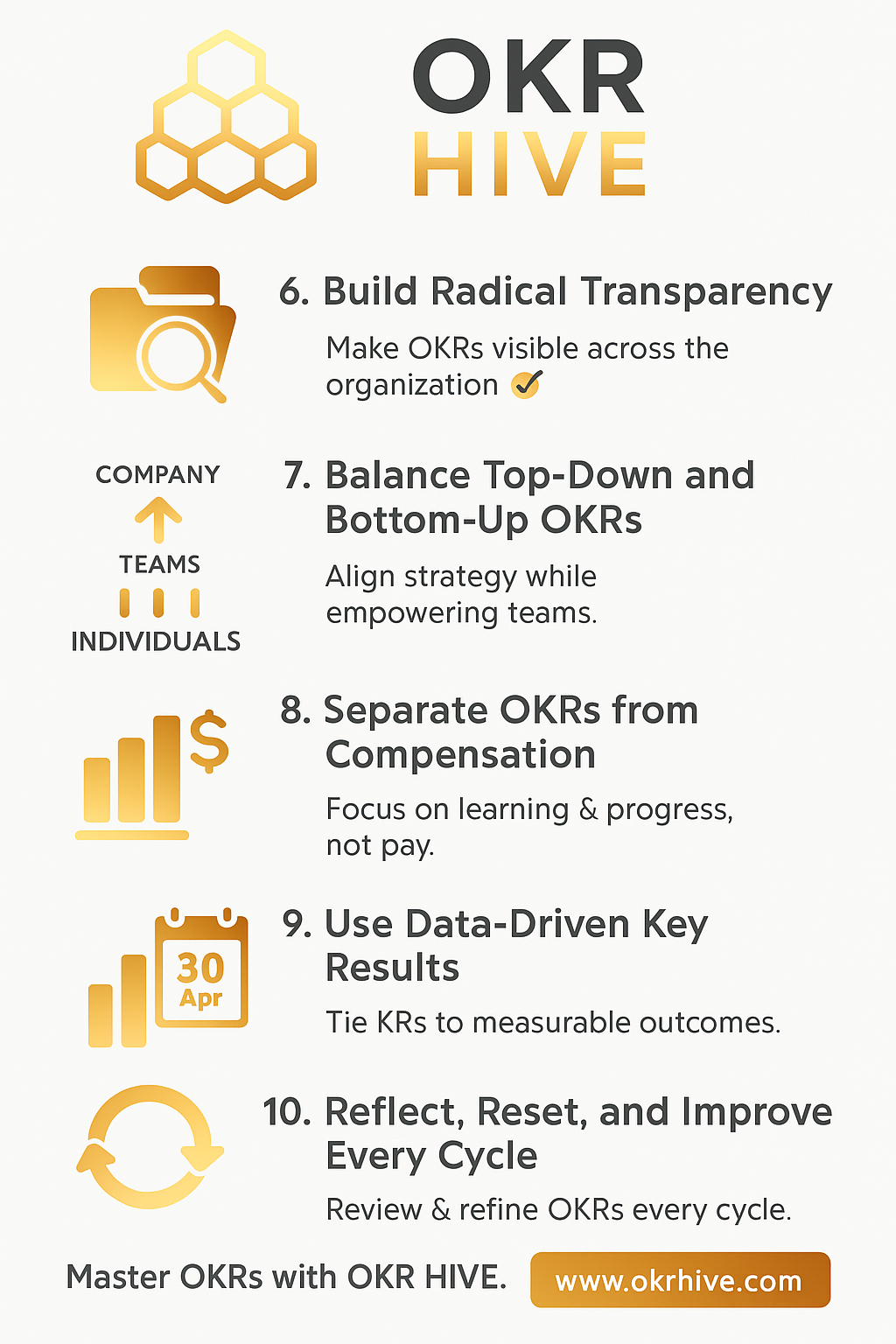
6. Build Radical Transparency
Hidden OKRs create silos, reduce collaboration, and weaken accountability.
Why it matters: Transparency helps teams understand dependencies, avoid duplication, and celebrate shared wins.
How to do it:
Make all OKRs visible across the organization using OKR Hive or similar platforms.
Encourage cross-team discussion of progress, obstacles, and wins.
Create a culture where it’s safe to share partial progress and failures.
Companies with transparent OKR practices report 30% higher employee engagement and better cross-departmental collaboration.
7. Balance Top-Down and Bottom-Up OKRs
OKRs fail when either completely dictated from above or left entirely to teams.
Why it matters: Balance ensures alignment with company strategy while empowering teams to set ownership and accountability.
How to do it:
Leaders define company-level OKRs.
Departments translate them into team-level OKRs.
Individuals create personal OKRs that contribute to team objectives.
Example:
Company Objective: Increase revenue by 25%.
Marketing Team Key Result: Generate 1,000 qualified leads.
Individual Objective (Content Writer): Publish 12 high-performing blog posts that drive lead generation.
This cascading model drives engagement and purpose.
8. Separate OKRs from Compensation
Directly linking OKRs to salary or bonuses encourages conservative goal-setting.
Why it matters: If employees fear failing OKRs, they’ll pick safe goals, undermining the purpose of stretch objectives.
How to do it:
Treat OKRs as growth and alignment tools, not a performance review metric.
Tie recognition to learning, collaboration, and innovative contributions instead of absolute completion.
Celebrate progress publicly to reinforce a growth-oriented culture.
Pro tip: Use OKR Hive to visually track achievements and celebrate milestones without financial pressure.
9. Use Data-Driven Key Results
Ambiguous key results make OKRs vague and hard to measure.
Why it matters: Measurable, data-driven OKRs improve focus, decision-making, and accountability.
How to do it:
Each key result should have a quantifiable metric and deadline.
Example: “Increase monthly recurring revenue by $100,000 by Q3.”
Avoid generic terms like “improve,” “enhance,” or “optimize” without numbers.
Pro tip: Tie metrics to real business outcomes, not vanity numbers, for actionable insights.
10. Reflect, Reset, and Improve Every Cycle
Without retrospectives, OKRs are repetitive exercises that don’t evolve.
Why it matters: Reflection allows teams to learn from mistakes, recognize patterns, and continuously improve OKR Implementation.
How to do it:
Conduct a 1-hour OKR retrospective at the end of each cycle.
Discuss:
What worked well?
What obstacles were faced?
What will we improve next quarter?
Document learnings and feed them into the next cycle.
Companies that actively reflect after each OKR cycle see 42% higher success rates in achieving objectives.
FAQs on OKR Implementation
Why is my OKR Implementation failing?
Most failures occur due to misalignment, overly complex OKRs, and lack of measurable outcomes. Simplifying objectives and using data-driven key results can turn it around.
How often should OKRs be checked?
Weekly check-ins maintain momentum; quarterly reviews allow reflection and reset.
Should small businesses use OKRs?
Yes. Streamlined teams often adapt faster, and OKRs bring clarity, focus, and alignment.
Can OKRs be tied to bonuses?
It’s not recommended. Separate OKRs from compensation to encourage stretch goals and innovation.
What’s the best OKR software for tracking process?
While spreadsheets work initially, OKR Hive streamlines visibility, alignment, and real-time tracking across teams.
Conclusion: Accelerate Results with Smarter OKR Implementation
OKR Implementation isn’t just goal-setting—it’s a system for alignment, focus, and execution speed.
By keeping objectives simple, aligning them with strategy, embracing stretch goals, focusing on outcomes, maintaining transparency, and using proper tools like OKR Hive, your organization can achieve faster, measurable results.
The key is discipline, reflection, and continuous improvement. Implement these hacks, and OKRs won’t just exist—they’ll drive real business growth and team engagement.


